A critical review of the artist’s manifesto to mark the launch of their website
Jon Gesalaga presents his work as a rare contemporary attempt to articulate a coherent philosophical framework for artistic creation in the digital age. His Manifesto and AI Statement, published at the launch of his website, demand thorough critical examination beyond their philosophical ambitions.
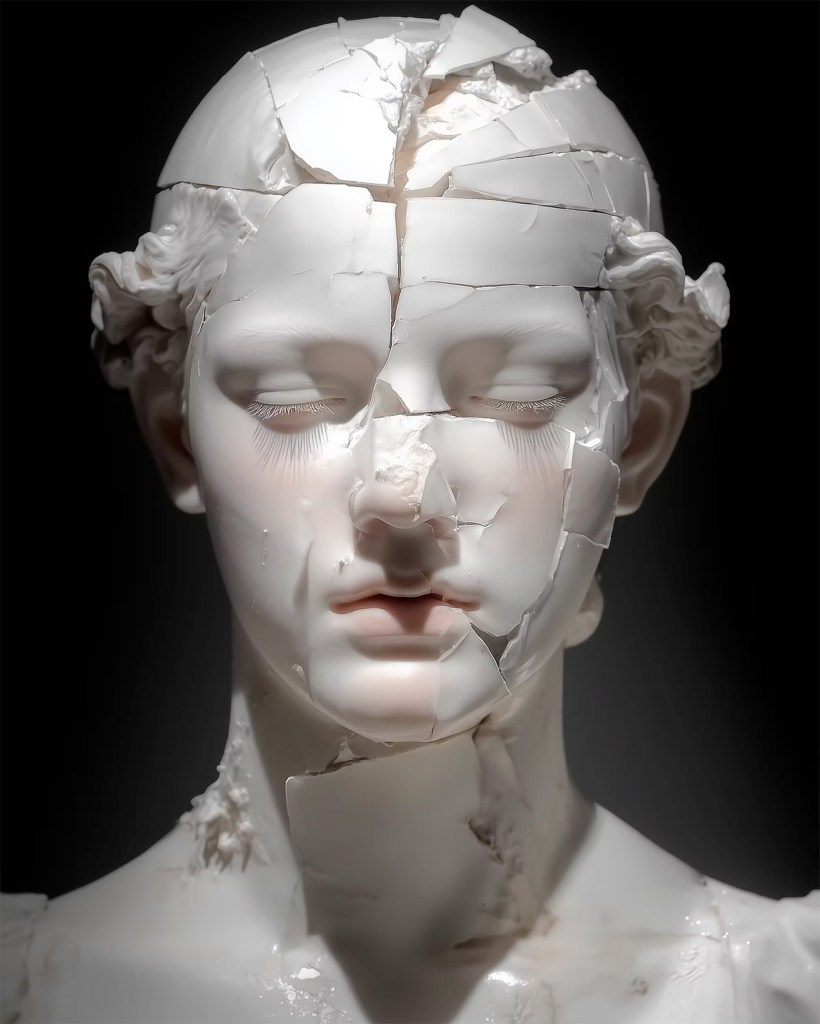
Gesalaga positions himself as a disruptor of visual flow, claiming that the visible is “never complete” and seeking to “fracture its surface.” While this rhetoric echoes familiar themes from philosophers Bataille and Deleuze, his contribution lies in applying these ideas to contemporary image saturation. Against “rapid consumption,” he proposes “suspension”: works that demand to be “inhabited as spaces.”
The theoretical framework ambitiously draws from Jung, Buddhism, Heraclitus, and philosopher Simone Weil—an eclectic synthesis that convincingly inscribes his practice within a tradition of “tensions” between the ephemeral and enduring, the concrete and abstract.
More provocative is his AI Statement, which positions artificial intelligence as the latest in a historical series of technological ruptures. His comparison with photography’s reception by painting is astute though familiar. What distinguishes his approach is the assertion that AI functions as “dark matter”—formless clay from which symbols emerge. This metaphor grants him creative agency while risking obscuring AI’s specific material conditions and ideological implications.
Gesalaga insists he creates “art with intelligence” rather than “AI art,” reflecting deep medium awareness. His process—selection, curation, intervention from AI-generated materials—recalls Duchamp’s ready-mades, but where Duchamp emphasized institutional frameworks, Gesalaga aims for transcendence, for “liturgy.”
This liturgical language, with terms like “Nigredo, Albedo, Baptême, Metanoia,” suggests a creation of metaphysical images, which, while truly bold, could create confusion with notions of material analysis of data collection, computational costs, and the biases inherent in AI.
Yet this project cannot be dismissed as mere techno-mysticism. His commitment to “symbolic thresholds” rather than “technical effects” suggests deeper engagement with digital meaning-making. When he writes that “AI forces the artist to confront their own judgment with greater rigor,” he identifies a crucial contemporary challenge.
The ultimate test will be whether his works justify these theoretical claims. Can his “suspension” provoke genuine contemplative engagement? Do his “symbols” open meaning rather than simply assert it?
Gesalaga’s statements announce a philosophical position that takes seriously both traditional meaning concerns and digital production realities. At a time when contemporary art seems content with surface effects, he insists on depth—”translating fragility into potency.” His project merits particular attention, not because it resolves debates about AI and artistic practice, but because it approaches them with appropriate philosophical complexity.
 Partfaliaz
Leave a comment